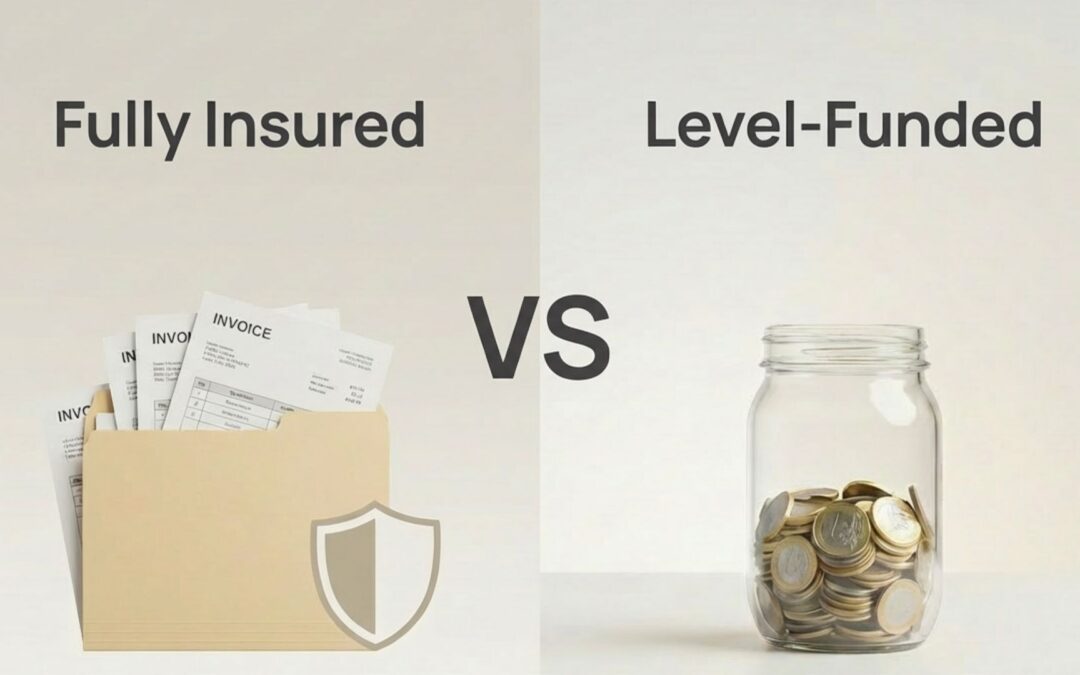
Fully Insured vs Level-Funded Plans: What Small Business Owners Should Actually Consider
At some point, most business owners reach the same moment during renewal season. Your premiums went up again. Not a little—enough to make you seriously question whether offering coverage is sustainable long term. That’s when you usually hear about a “level-funded” option.
Many employers assume it’s just another complicated insurance product, but in reality, the discussion around level funded vs fully insured coverage has become one of the most important decisions small businesses make in 2026. The choice can significantly affect both your benefits budget and your renewal stability, especially for companies trying to grow while keeping predictable expenses.
Below is a clear explanation, without insurance jargon, of how these two plan types actually work and which situations they fit best.

What Is a Fully Insured Health Plan?
A fully insured health plan is the traditional group insurance most employers have offered for decades.
Here’s how it works: You choose a carrier. You pay a fixed premium every month. The insurance company assumes all financial risk. Employees use the coverage and the carrier pays claims.
From an employer perspective, it’s simple. You don’t need to track claims or worry about high medical expenses because the carrier absorbs the risk.
Advantages to a fully insured health plan:
- Predictable monthly cost
- Minimal administration
- Familiar structure
- Easier employee understanding
The downside: Premium increases are based on broader risk pools and medical inflation. Even if your employees rarely use healthcare, your renewal can still rise significantly.
That’s why many small employers begin looking for an alternative to fully insured health insurance after a few renewal cycles.
What Is a Level-Funded Health Plan?
A level funded health plan sits between traditional insurance and self-funding. You still make a consistent monthly payment, but instead of sending the entire premium to an insurance carrier, the payment is split into three parts:
- Administrative fees
- Stop-loss protection (catastrophic coverage)
- A claims fund used to pay employee medical claims
If claims are lower than expected, unused claim funds may be returned to your company at renewal or credited toward the next year. This structure is why small business level funded plans have grown rapidly in popularity over the past few years.
Level Funded vs Traditional Insurance: The Core Difference
The simplest way to understand level funded vs traditional insurance is this:
- Fully insured: you pay for risk whether it occurs or not
- Level-funded: you pay primarily for the healthcare your employees actually use
You are still protected against large claims because stop-loss coverage caps the employer’s exposure. In other words, you get some of the financial efficiency of self-funding without the catastrophic risk.

Level Funded Health Insurance Pros and Cons
No plan type is perfect for every company. The key is understanding the tradeoffs.
Benefits of Level-Funded Plans
- Potential refunds or credits
- More stable renewals
- Lower long-term trend increases
- Detailed claims reporting
- Often broader networks
- Possible level funded plan savings after year one
For many employers, the biggest advantage is predictability at renewal. Instead of large unpredictable increases, adjustments tend to reflect actual usage.
Considerations and Risks
- Requires relatively healthy participation
- Slightly more onboarding explanation for employees
- Not ideal for very small or very high-risk groups
This is why level funded health insurance for small business works best when the workforce is stable and participation is strong.
Cost Comparison
For many companies, the decision ultimately comes down to cost control. A fully insured plan often starts with a lower initial commitment but experiences larger annual increases.
A level-funded plan may begin similarly priced, but over two or three years employers frequently see flatter renewals and occasional refunds if claims are favorable. In real-world scenarios, businesses with 10–40 employees often transition because a level-funded structure helps prevent compounding premium spikes.
Why Employers in Idaho Are Looking at Level-Funded Plans
We’ve noticed a growing trend among Idaho employers. Smaller companies that previously believed self-funding was only for large corporations are discovering level-funded options provide a middle ground.
Healthcare costs in many regional markets have risen quickly. Employers trying to offer benefits while keeping payroll stable are increasingly exploring a level funded health plan as a practical alternative rather than eliminating coverage entirely.
It allows companies to keep offering benefits without feeling locked into renewal increases they can’t control.
Which One Is Better?
There isn’t a universal winner in the level funded vs fully insured comparison.
A fully insured plan may be the better choice if:
- You want maximum simplicity
- Your workforce changes frequently
- You prefer no claims involvement at all
A level-funded plan may fit better if:
- You’ve experienced large renewals
- Your employees are relatively stable
- You want long-term cost management
- You want transparency into healthcare spending
The right plan depends less on company size and more on employee demographics and your goals as an employer.
Before You Decide
Many owners think changing plan types means a complicated or risky transition. In reality, most employees barely notice the difference because networks, deductibles, and ID cards function the same way.
What does change is how your business absorbs healthcare costs over time.
At J.C. Lewis Insurance Services, we help employers compare a fully insured health plan and a level funded health plan side-by-side so you can see realistic projections, not just marketing promises. If you want to know whether your company in Idaho would benefit from switching, we can review your current renewal and walk through the numbers with you.
A short conversation now can prevent several years of avoidable premium increases later. Reach out today to learn more.
