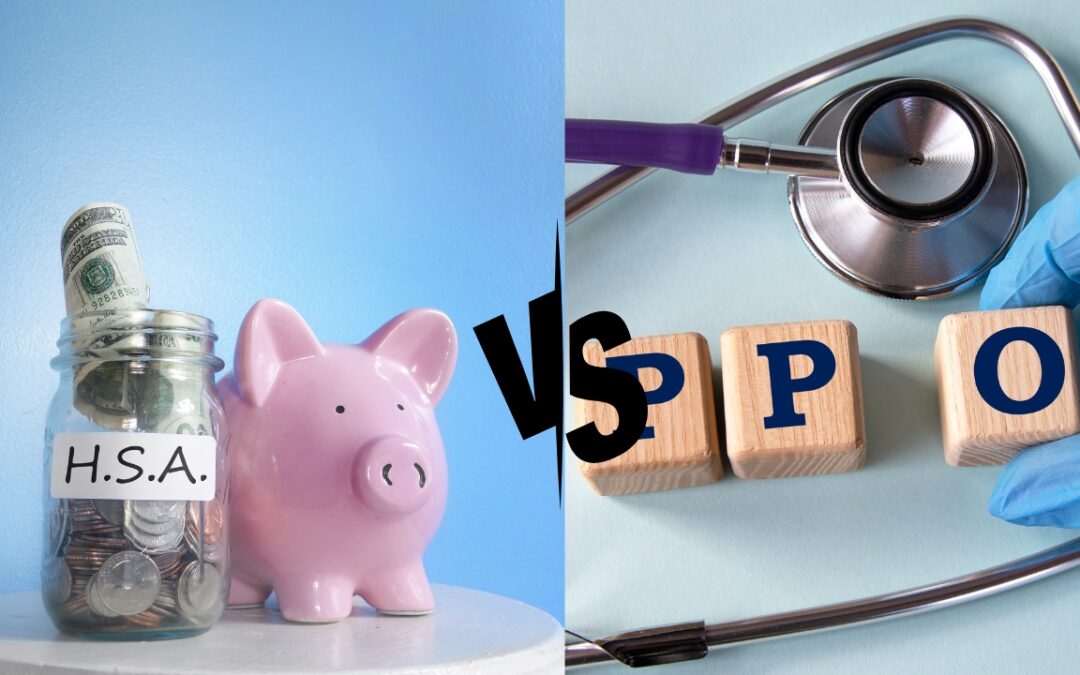
When it comes to choosing the right healthcare plan for your small business, flexibility and choice are key considerations. For many small business owners in California and Arizona, the decision often comes down to two popular options: Health Savings Account (HSA) plans and Preferred Provider Organization (PPO) plans.
As a recent article at The Motley Fool sums up,
“If you’re choosing among different types of health insurance plans, then you may be weighing a health savings account (HSA) versus a preferred provider organization (PPO) plan. An HSA can help you to save money for medical expenses, while a PPO plan gives you access to a network of healthcare providers.”
Each offers unique benefits, but understanding their differences can help you select the best option for your employees and your budget. Understanding the flexibility and choices offered by both HSAs and PPOs can help you make an informed decision.

Understanding Health Savings Accounts (HSAs)
An HSA is a tax-advantaged savings account that’s paired with a High Deductible Health Plan (HDHP). Employees can contribute pre-tax dollars to the account, which can then be used to pay for qualified medical expenses such as doctor visits, prescriptions, and even some dental and vision care. HSAs are particularly attractive because they offer multiple tax benefits:
- Tax-deductible contributions: Employees contribute pre-tax dollars, lowering their taxable income.
- Tax-free growth: Funds in an HSA grow tax-free, similar to a retirement account.
- Tax-free withdrawals: When funds are used for qualified medical expenses, there are no taxes on withdrawals.
One of the standout features of an HSA is the flexibility it offers employees. Unlike other types of health insurance, an HSA is fully owned by the employee. This means that even if they change jobs or leave the company, the funds in their HSA remain theirs to use for future medical expenses. Additionally, unspent funds roll over year to year, allowing employees to build substantial savings over time, potentially using these funds for healthcare costs in retirement.
Exploring PPO Plans: Flexibility In Network Access
A PPO, or Preferred Provider Organization, is a type of health plan that offers more flexibility in choosing healthcare providers. With a PPO, employees can choose to see both in-network and out-of-network providers, although care from in-network providers is usually covered at a higher percentage. PPOs do not require employees to choose a primary care physician or obtain referrals to see specialists, which can be a major advantage for those who need regular specialized care.
PPOs are often favored by businesses and employees who want more freedom when it comes to selecting healthcare providers. Employees have the ability to see out-of-network doctors and specialists, although this typically comes with higher out-of-pocket costs compared to in-network services. The key trade-off with PPOs is that while they offer greater provider flexibility, they tend to come with higher monthly premiums compared to HSA/HDHP plans.
For small businesses in California and Arizona, where the availability of healthcare providers can vary by region (particularly in rural areas), PPOs offer a valuable solution by expanding access to care beyond a limited network.
Comparing Cost Structures: Premiums, Deductibles, And Out-Of-Pocket Costs
One of the most important factors for any business when selecting a healthcare plan is the cost structure. Both HSAs and PPOs offer different approaches to managing healthcare costs.
- HSAs: With an HSA, the plan is paired with an HDHP, which typically has lower premiums but higher deductibles. This means that employees may have to pay more out-of-pocket before their insurance starts covering expenses. However, the tax benefits of the HSA can help offset these costs. Employees also have the flexibility to decide how much to contribute to their HSA, giving them more control over their healthcare spending.
- PPOs: On the other hand, PPOs come with higher premiums but lower deductibles, making them more appealing to employees who expect to use healthcare services more frequently. PPOs generally cover a larger portion of medical costs upfront, which can result in lower out-of-pocket expenses for employees, particularly when using in-network providers.
The key difference here is that HSAs are best suited for employees who are generally healthy and use healthcare services infrequently, while PPOs are better for those who may need more consistent care.
Flexibility In Managing Healthcare Expenses
Another area where HSAs and PPOs differ is in how healthcare expenses are managed. HSAs give employees the ultimate flexibility in controlling their healthcare dollars. Since employees own their HSA, they decide when and how to use the funds for qualified expenses. They can also choose to save their funds for future healthcare needs or invest them for long-term growth. This flexibility is particularly appealing for younger employees or those planning for retirement.
PPOs, on the other hand, offer flexibility in terms of provider choice. Employees can visit any provider, including specialists, without needing a referral. While PPOs provide greater freedom in accessing care, the cost-sharing is more structured, with employees responsible for co-pays, deductibles, and coinsurance.
Suitability For Small Businesses In California And Arizona
The choice between an HSA and a PPO can depend heavily on the type of business you run and the needs of your employees. In California, where the tech industry thrives and many employees are younger, healthier, and more likely to value long-term savings, an HSA may be the better option. These employees are more likely to benefit from the tax advantages and the ability to invest unused funds for the future.
This has been brought out in recent years. As CNBC article noted,
“According to data from the Charles Schwab 2022 401(k) Participant Study, 48% of Millennials and Gen Z’ers who are offered the option to contribute to a Health Savings Account (HSA) choose to do so. This move is motivated by the desire to start saving for healthcare-related expenses in retirement.”
The popularity tends to reveal itself in particular industries. For example, USAFacts.org found that in July 2023, about a quarter of young people aged 16 to 24 worked in leisure and hospitality, the highest percentage of young people of any industry.
In Arizona, where industries like construction and agriculture have a higher risk of physical injuries, a PPO might make more sense. Employees in these industries may need more immediate access to healthcare providers and specialists, which a PPO plan can offer. The higher premiums may be worth it for the lower out-of-pocket costs and more comprehensive coverage.
The Long-Term Benefits Of HSAs Vs. PPOs
HSAs offer a long-term advantage that PPOs cannot: the ability to save for future healthcare expenses. Funds in an HSA roll over each year and can even be invested, similar to a 401(k). This makes an HSA an attractive option for employees who want to build a nest egg for medical costs in retirement.
PPOs, meanwhile, provide more immediate access to care and greater flexibility in terms of provider choice. For employees who anticipate using healthcare services frequently or those with chronic conditions, PPOs can offer more peace of mind by covering a larger portion of medical costs upfront.

Employee Engagement And Satisfaction With Hsas And Ppos
Employee satisfaction is a crucial consideration when selecting a healthcare plan. HSAs tend to appeal to employees who are financially savvy and enjoy the control and flexibility these plans offer. HSAs can also promote healthier behaviors, as employees may become more engaged in managing their healthcare spending.
PPOs, on the other hand, tend to be more straightforward for employees to navigate. There’s no need to worry about managing an HSA or figuring out how much to contribute. For employees who value ease of use and wide access to care, PPOs may be more attractive.’
Choosing The Right Option For Your Business
Ultimately, the choice between an HSA and a PPO depends on the needs of your employees and your business’s budget. HSAs offer long-term financial benefits, tax advantages, and flexibility in managing healthcare expenses, making them a great option for younger or healthier employees. PPOs, with their broader access to providers and lower out-of-pocket costs for frequent care, are ideal for employees who value immediate access to a wide network of doctors and specialists.
Consulting with an experienced insurance broker will help you evaluate these options and choose the plan that best meets the needs of your small business, whether you’re in California or Arizona.
J.C. Lewis: Your Partner In Optimizing Health Benefits For Your Business
At J.C. Lewis Insurance Services, we’re proud to offer a range of health insurance options from top-tier providers licensed in California and Arizona. Our expertise and certifications allow us to deliver comprehensive coverage tailored to the needs of small group employers.
Navigating the complexities of employee health benefits can feel overwhelming, but you don’t have to do it alone. Our team at J.C. Lewis Insurance Services is here to guide you every step of the way—from selecting the right plan to managing renewals and ongoing support.
We also specialize in helping seniors find Medicare supplemental and prescription drug plans that fit their needs.
Whether you’re exploring Small Group Insurance (1-50 Employees), considering the Small Business Health Options Program (SHOP), or addressing any employer-related insurance concerns, J.C. Lewis is committed to finding the ideal solution for your business.
Contact us today! Your peace of mind is our mission, and we’re dedicated to helping you secure the best insurance package for your unique needs.